We are the leading trade association for dietary supplements, natural health & sports nutrition, medical & functional foods, probiotics, and natural personal/home care products.
Founded in 1936, the Natural Products Association is the nation’s largest and oldest nonprofit organization dedicated to the natural products industry. NPA represents over 700 members accounting for more than 10,000 retail, manufacturing, wholesale, and distribution locations of natural products, including foods, dietary supplements, and health/beauty aids. NPA unites a diverse membership, from the smallest health food store to the largest dietary supplement manufacturer.
NPA is recognized for its strong lobbying presence in Washington, D.C., where it serves as the industry watchdog on regulatory and legislative issues. In 1994, NPA played a key role in the passage of the Dietary Supplement Health and Education Act (DSHEA). This important legislation strikes a balance between the need for consumers to have access to and information about safe and effective dietary supplements while also preserving the government’s interest in protecting the public from unsafe products and false and misleading claims.
What are natural products?
Natural products are represented by a wide array of consumer goods that grow in popularity each year. These products include natural and organic foods, dietary supplements, pet foods, health and beauty products, “green” cleaning supplies and more. Generally, natural products are considered those formulated without artificial ingredients and that are minimally processed.
How are natural products regulated?
The U.S. Department of Agriculture sets standards for use of the term “natural” for meat and poultry. The agency also regulates use of the term “organic” under the Organic Foods Production Act. The U.S. Food and Drug Administration does not have a formal definition for the term “natural.” However, a flood of class action lawsuits regarding use of the term has created significant uncertainty and costs for the food industry, underscoring the need for clarity from regulators.
According to FDA, it has “considered the term ‘natural’ to mean that nothing artificial or synthetic (including all color additives regardless of source) has been included in, or has been added to, a food that would not normally be expected to be in that food.” But FDA explained its policy was not intended to address such food production methods as the use of pesticides, and it did not explicitly address food processing or manufacturing methods, such as irradiation, pasteurization, or thermal technologies. Also, FDA did not consider whether the term “natural” should describe any nutritional or other health benefit.
In 2015, FDA requested comments on use of the term in the labeling of human food products, including foods that are genetically engineered or contain ingredients produced through the use of genetic engineering. The agency received nearly 7,700 comments through a comment period that closed in May 2016.
Natural Facts
Nutrition Business Journal (NBJ) defines the natural products industry as dietary supplements, natural and organic food and beverage, functional food and beverage, and natural and organic personal care items like deodorants, feminine hygiene and skin care products.
In 2024, the natural products industry generated $325.21 billion in sales, according to NBJ. Sales in 2025 are projected to grow 5.4% to $342.71 billion. (NBJ 2024 figures and 2025 projections exclude sales of household category products like laundry detergents and cleaning products).
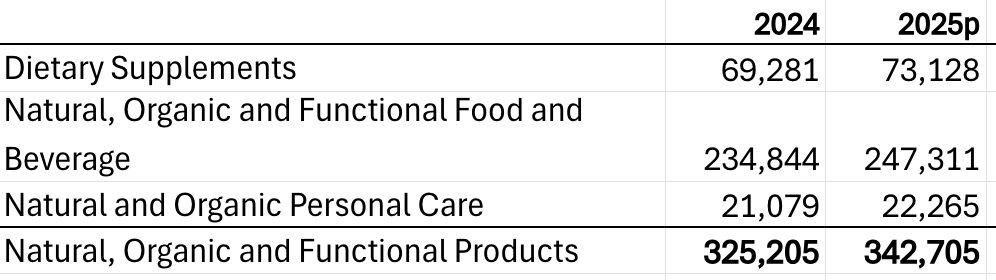
Source: State of Natural Market Insights (Nutrition Business Journal)